Prices are estimates. How we get them

Garage flake that handles humidity, salt-air houses on the Pinellas side, and an honest pause when a slab is pushing vapor. Photo estimates.
Call Get a free quoteTampa Bay concrete lives in humid air, afternoon storms, and, on the Pinellas side, salt. Garages are on slabs. There is rarely a basement to hide a moisture problem. If vapor is moving up through the concrete, a coating will tell you by blistering. Local pros test and they wait when the reading says to wait.
Salt air in St. Petersburg, Clearwater, and Largo shows up as corroded tracks, damp corners, and aluminum dust from screen cages that are being rebuilt. Inland — Brandon, Riverview, Wesley Chapel — the issue is more often a newer slab and a garage that stays shut in August until it feels like a greenhouse.
Hot tires still matter. A car that crossed a sunbaked driveway can mark a soft coat. We are a service-area crew with no published street address. Send the city, because a beach condo and a Riverview garage are not the same access.

The main request: a two-car slab that dusts and stains. Full flake hides sand and tire marks and adds grip when a storm blows rain under the door.
A covered lanai can take a decorative coat if it stays out of standing water. An open slab in full Gulf sun and rain usually should not. A local pro will say so.
Inland shops in Plant City and Lakeland see humidity plus oil. Ventilation during cure is part of the quote, not an extra.
Pinellas condos and one-car garages can be coated when the association allows it and the elevator or alley works. The owner has to request it.
Small retail and kitchen floors that need to mop clean. The building owner approves the work.
Wesley Chapel and Riverview slabs are young. Humidity plus a new pour is a blister risk. Local pros ask when the concrete went down.
A sealed floor does not let everyday spills and humid air disappear into the slab. It also will not hide an active vapor problem, which is why local pros test.
Pinellas garages track sand and salt. Flake gives that grit a surface you can rinse instead of a porous slab that keeps it.
When a garage becomes storage for everything you moved in from the lanai, a coated floor is the difference between a mop and a stain.
Afternoon storms wet the threshold. A broadcast texture is safer than a slick gloss at the door.
Example flake and metallic floors from freely licensed photos. They are not Tampa Bay jobs we are claiming.


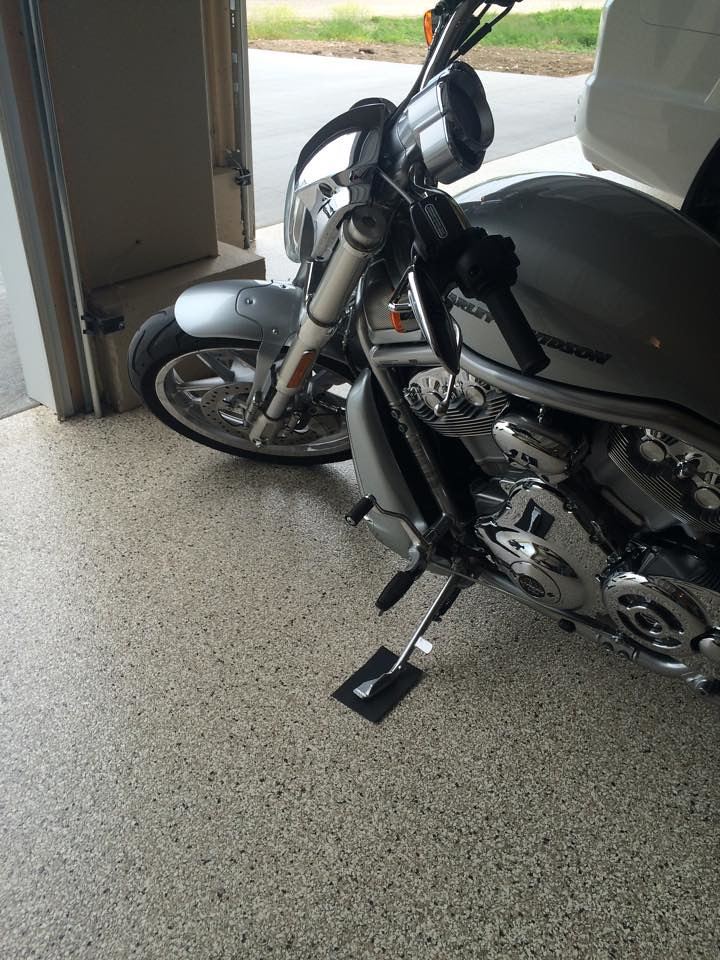
These photos are examples of flake, metallic, and solid systems. They are not claimed as jobs in Tampa. Color is chosen for your slab.
Full flake is the default from South Tampa to Palm Harbor. It hides sand, adds grip, and does not ask you to pretend the air is dry.
A shop that wants marked zones and a simpler recut later does better with a solid system than with a decorative metallic.
A metallic or wood-look coat is for a lanai or room that is not pumping moisture. Pretty and blistered is still blistered.
Rinse salt and sand, especially on the Pinellas side. Keep patio furniture pads under metal feet. A coating handles humidity better when grit is not grinding it every day.
Humidity is regional. Salt, new slabs, and condo rules are local. The town pages separate them.
Ambient humidity changes the cure, and moisture inside the slab can blister a coat. Local pros check both. Local pros do not install over an active vapor problem and hope.
Covered lanais sometimes, if water does not stand on them. Fully exposed slabs in sun and storms are often a no.
Yes. Hillsborough, Pinellas, and nearby Pasco and Polk towns are listed. Access across the bridges belongs in the schedule.
No. Local pros come to the slab. Start with a photo and the city.
No. They are examples of finishes so you can see flake versus metallic. The quote is for your concrete.
A coating can fail below the surface even when the finished floor looked smooth on installation day. Moisture vapor can push through concrete, while a coating applied outside its temperature or humidity limits may cure unevenly. Poorly removed oil, dust, paint, or an overly smooth slab can also weaken the bond. The result may be peeling, bubbles, soft areas, or patches that wear away under tires and foot traffic.
A redo is not just another coat. Failed material usually has to be mechanically removed, and that work can create dust, noise, and time without access to the garage or shop. The slab then needs another inspection for contamination, cracks, and weak concrete before the coating process can begin again. If moisture caused the first failure, that condition needs attention before new material goes down.
Repairs can also change the appearance of the finished floor. Grinding may leave a different profile or expose repairs that were hidden before, and matching a partial repair to an older decorative finish can be difficult. Some slabs need more than one preparation pass. Ask what happens if the coating exposes a weak area or a moisture concern; a clear stop-and-review plan is better than covering it and hoping.
Compare the work plan, not just the coating name. A useful quote describes how the slab will be evaluated, what preparation is included, how cracks and joints will be handled, and which layers make up the system. It should identify the intended surface profile, often described as a CSP, and explain how that profile will be created. “Prep included” is not enough detail to judge whether two proposals cover the same work.
Ask how moisture will be assessed and what result would change the plan. Calcium chloride testing measures moisture vapor emission at the surface over a test period. In-situ relative-humidity testing uses probes in the slab to assess internal conditions. These methods measure different things. The contractor should state which method is appropriate, how results are interpreted against the selected coating’s limits, and whether testing is included or separate.
Ask for the product types and layer sequence in writing, without relying on a decorative sample alone. Clarify whether the quote includes primer, base coat, flake broadcast if selected, and a compatible protective topcoat. Ask what the crew does with oil stains, old paint, existing coatings, control joints, and cracks. Also confirm the temperature and humidity range for installation, the recoat window, and the time before normal use.
Epoxy is often used as a base or build layer because it can provide a substantial coating system when the slab is properly prepared and conditions suit the material. Its working and recoat times depend on the formula and site conditions. Some epoxy finishes can amber with ultraviolet exposure, so a garage door that brings in strong sun or an exposed outdoor area deserves a specific discussion about the finish layer.
Polyaspartic coatings are commonly chosen where a quicker return to service or better resistance to sunlight is important. Their fast cure can also leave less time to spread material and broadcast flake evenly. Heat and humidity affect handling, so the installer needs a schedule and crew size suited to the actual conditions. A fast cure is not a substitute for correct slab preparation or moisture readings.
Polyurea is a broad family of coatings, and its flexibility, cure speed, and intended use depend on the formulation. It is not automatically a better choice for every garage or shop. In Tampa Bay, ask how the complete system—not just its topcoat—fits the slab’s moisture condition, sun exposure, traffic, and expected cure window. A compatible primer, base, and topcoat matter more than choosing a label in isolation.
Calcium chloride testing estimates moisture vapor emission at the concrete surface during the test period. In-slab RH testing uses probes to measure relative humidity inside the slab. They are not interchangeable readings. Ask which method fits the coating system and site conditions, and have the contractor explain how the result compares with the material’s published limits.
Diamond grinding removes surface contaminants and creates a mechanical profile that a coating can bond to. Acid etching can be inconsistent, may not remove oil or old coatings, and leaves residue if it is not thoroughly rinsed and neutralized. The right preparation depends on the slab and coating, but the contractor should be able to describe the profile the system requires.
Cracks and control joints serve different purposes. A crack may need repair after its cause and movement are considered, while a control joint is designed to accommodate slab movement and is often treated differently. Filling every joint rigidly can lead to renewed cracking or separation. Ask which locations will be repaired, left open, or detailed in another way.
Sometimes, but only if the existing layer is firmly bonded, compatible, and suitable as a base. Loose or poorly bonded material can take the new coating with it. The contractor should inspect the old finish, test adhesion where appropriate, and state whether it will be removed or retained. Covering an unknown coating without checking creates avoidable risk.
Some epoxy finishes can amber or shift in appearance after ultraviolet exposure. The degree depends on the material and exposure. Ask whether the selected system uses a UV-stable finish layer and whether that layer is suitable for the area’s sunlight. A sample viewed indoors may not show how the floor will look near an open garage door or on an exposed slab.
Follow the installer’s written return-to-service schedule, not a fingertip test or a surface that merely looks dry. Foot traffic and vehicle traffic can have different waiting periods, and temperature and humidity affect curing. Keep tires, stored items, and heavy equipment off until the specified time has passed. Ask for the schedule before work begins so you can plan access.
Yes. A smooth finish can be slick with rainwater, sand, or cleaning solution. Texture can improve traction, but the amount and type affect cleaning and the final appearance. Ask to compare a sample with the texture you expect, especially near the garage entrance. Keep in mind that no coating makes wet grit harmless; routine sweeping and rinsing still matter.
Use a soft broom or dust mop to remove grit before it is dragged across the finish. For routine washing, use a mild cleaner approved for the coating and rinse away residue; avoid abrasive pads and unapproved solvents. Clean oil and other spills promptly. Ask the installer for care instructions for the exact topcoat, since maintenance guidance can vary by system.
Send a photo that shows the whole slab and any dark, damp-looking areas. Name the city so local pros know if salt air is part of the story.
Tampa Epoxy Floors is an independent referral service that connects you with local epoxy flooring pros.
Open this site on your phone

Tampa Epoxy
tampaepoxypros.com
Point your phone camera at the code